
Copyright © 2026 SUNCRAFT SOLAR | ABN : 38 689 488 266 | Licence Number : NSW : 486169C | SA: BLD 356274

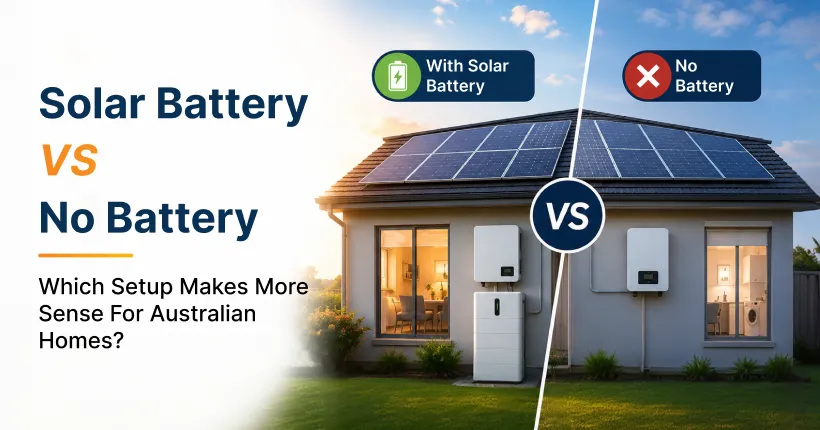
For many Australian homeowners, installing solar is an easy decision. The harder question comes next: should you add a battery or stick with solar alone?
The answer depends on how and when your household uses electricity. While a solar-only system can deliver significant savings, adding battery storage changes how your energy is used and stored.
In this guide, we’ll compare solar battery vs no battery setups, explain the real-world differences, and help you decide which option suits your home.
A solar system without a battery works like this:
This is the typical solar system without battery backup used in many Australian homes.
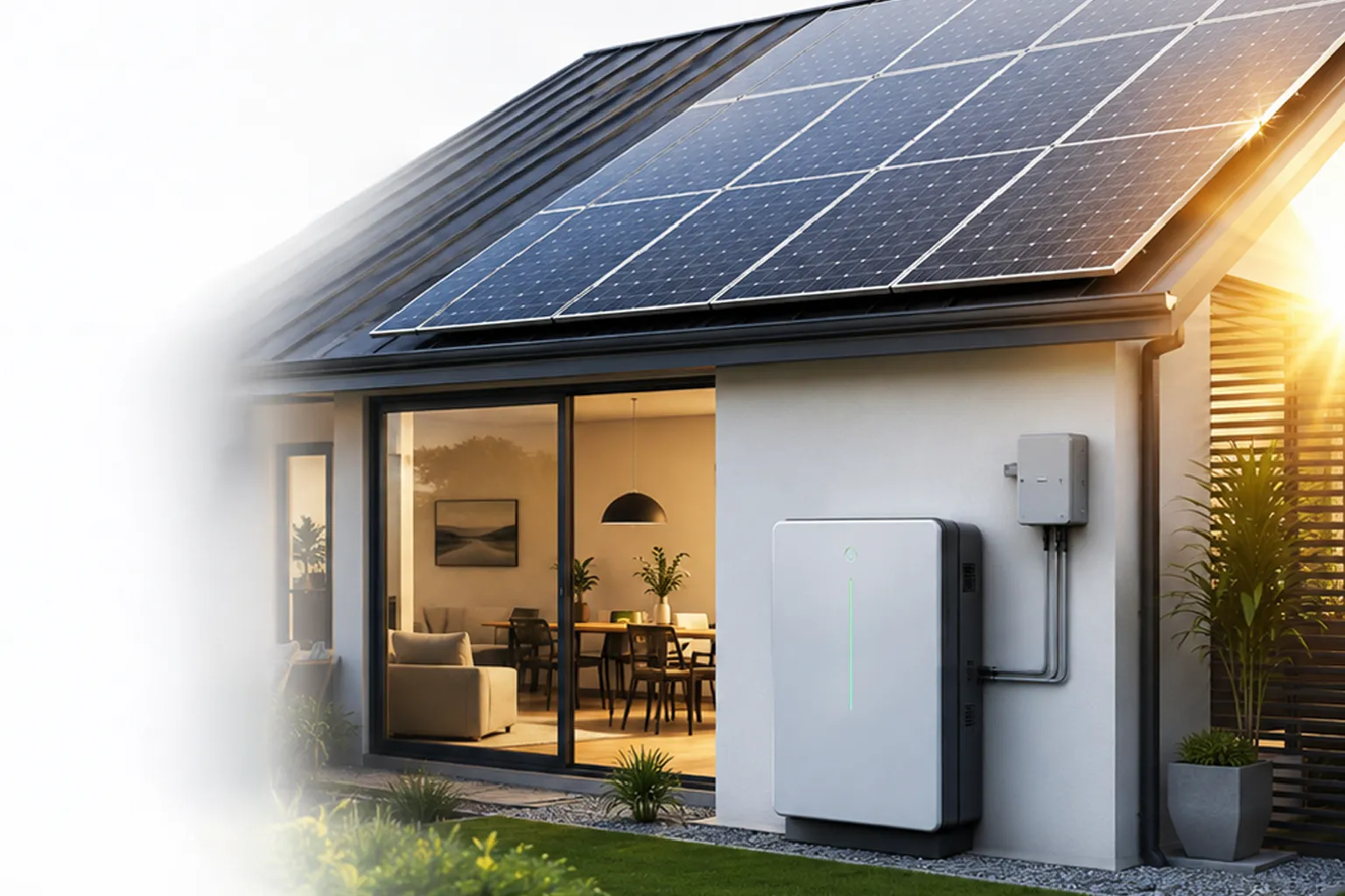
With solar panels with battery storage, excess solar energy is stored instead of being exported immediately.
The stored energy can then be used:
This is the fundamental difference in the solar with battery vs without battery debate.
A simple solar battery comparison shows how each system affects everyday energy use.
|
Feature |
Solar Only |
Solar + Battery |
|
Daytime solar usage |
Yes |
Yes |
|
Night-time solar usage |
No |
Yes |
|
Grid dependence |
Higher |
Lower |
|
Backup capability |
No |
Possible* |
|
Upfront cost |
Lower |
Higher |
|
Energy self-consumption |
Moderate |
High |
Backup capability depends on battery type and system design.
When looking at the difference between solar battery and no battery, the main advantage of a battery is the ability to use your own solar power after sunset.
A home solar and battery comparison often comes down to whether your household uses most of its electricity during the day or during the evening.
A battery isn’t always necessary.
A solar system without battery backup may be the better option if:
If someone is usually home during daylight hours, much of the solar generation can be consumed directly.
Solar-only systems have a lower upfront cost and still deliver substantial power bill savings.
In some areas, exporting excess solar energy may still provide reasonable returns, making batteries less attractive financially.
For many households, starting with solar and adding a battery later can be a practical approach.
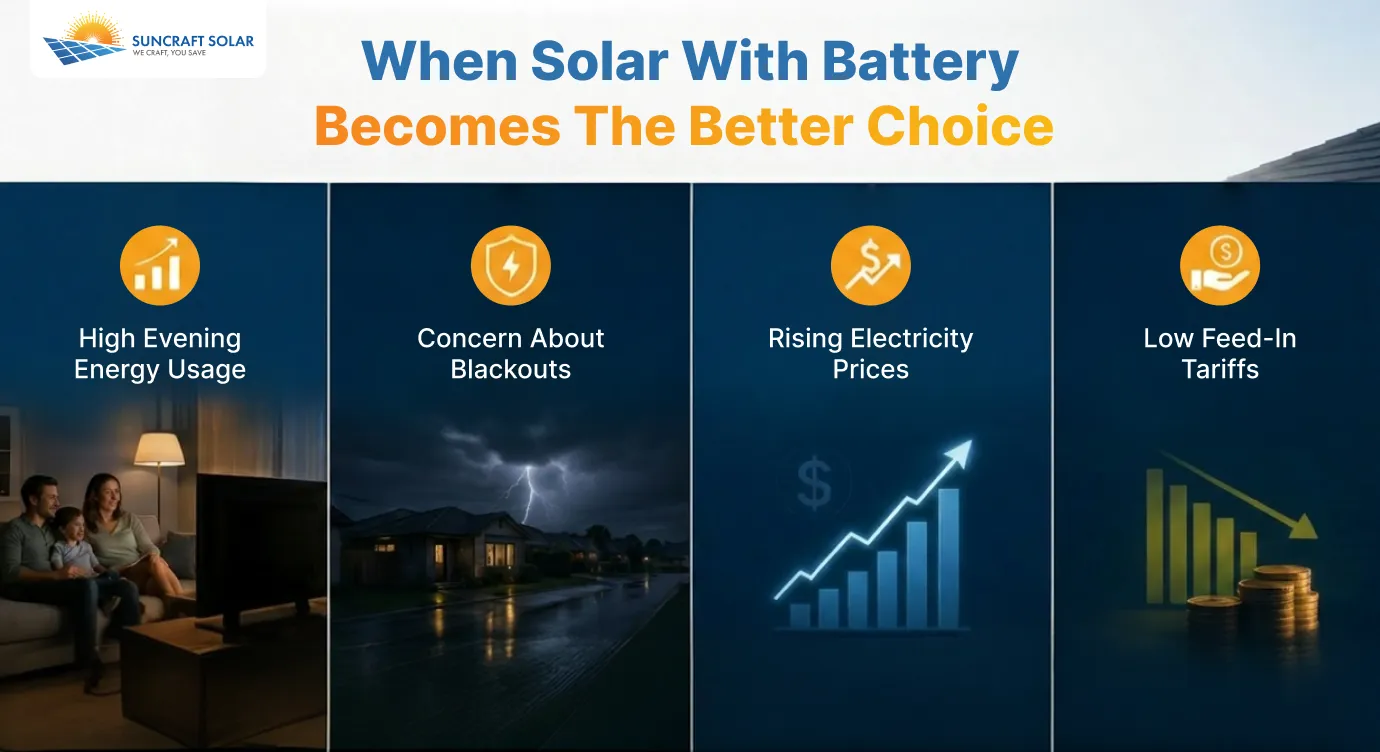
There are situations where solar with battery vs without battery becomes a very easy decision.
A battery can make sense if your home uses a lot of electricity after sunset, including:
Many homeowners install batteries for backup power rather than purely financial reasons.
As electricity costs continue to increase, storing your own solar energy becomes more valuable.
Many Australians now export electricity for only a few cents per kWh while paying significantly more to buy it back later.
This is where the difference between solar battery and no battery becomes most noticeable.
One of the easiest ways to understand solar battery vs no battery is to look at how each affects your power bill.
A solar-only system reduces the amount of electricity you buy during daylight hours.
However:
A battery stores excess solar energy and shifts it into the evening.
This allows you to:
In most solar battery comparison scenarios, batteries don’t necessarily generate more solar power. They simply help you use more of the solar power you already produce.
That’s why many homeowners research solar with battery vs without battery focus on evening usage patterns first.
Not every household needs the same solution.
|
Your Situation |
Best Fit |
|
Mostly home during the day |
Solar only |
|
High evening electricity usage |
Solar + battery |
|
Frequent blackouts |
Solar + battery |
|
Looking for lowest upfront cost |
Solar only |
|
Planning to buy an EV |
Solar + battery |
|
Want maximum energy independence |
Solar + battery |
A home solar and battery comparison should always start with your actual usage habits, not what your neighbors are doing.

The solar battery vs no battery decision isn’t about which system is universally better. It’s about which system matches your lifestyle.
If your goal is the lowest upfront investment and strong daytime savings, a solar system without battery backup may be enough.
If you want to maximize self-consumption, reduce evening grid usage, and gain more energy independence, solar panels with battery storage may provide greater long-term value.
Not sure which option suits your home? The team at SunCraft Solar can review your energy usage and help you compare the real-world benefits of solar with battery vs without battery before you make a decision.
Copyright © 2026 SUNCRAFT SOLAR | ABN : 38 689 488 266 | Licence Number : NSW : 486169C | SA: BLD 356274

