
Copyright © 2026 SUNCRAFT SOLAR | ABN : 38 689 488 266 | Licence Number : NSW : 486169C | SA: BLD 356274


Power bills aren’t what they used to be. Across NSW, QLD, WA and SA, we’re seeing the same pattern:
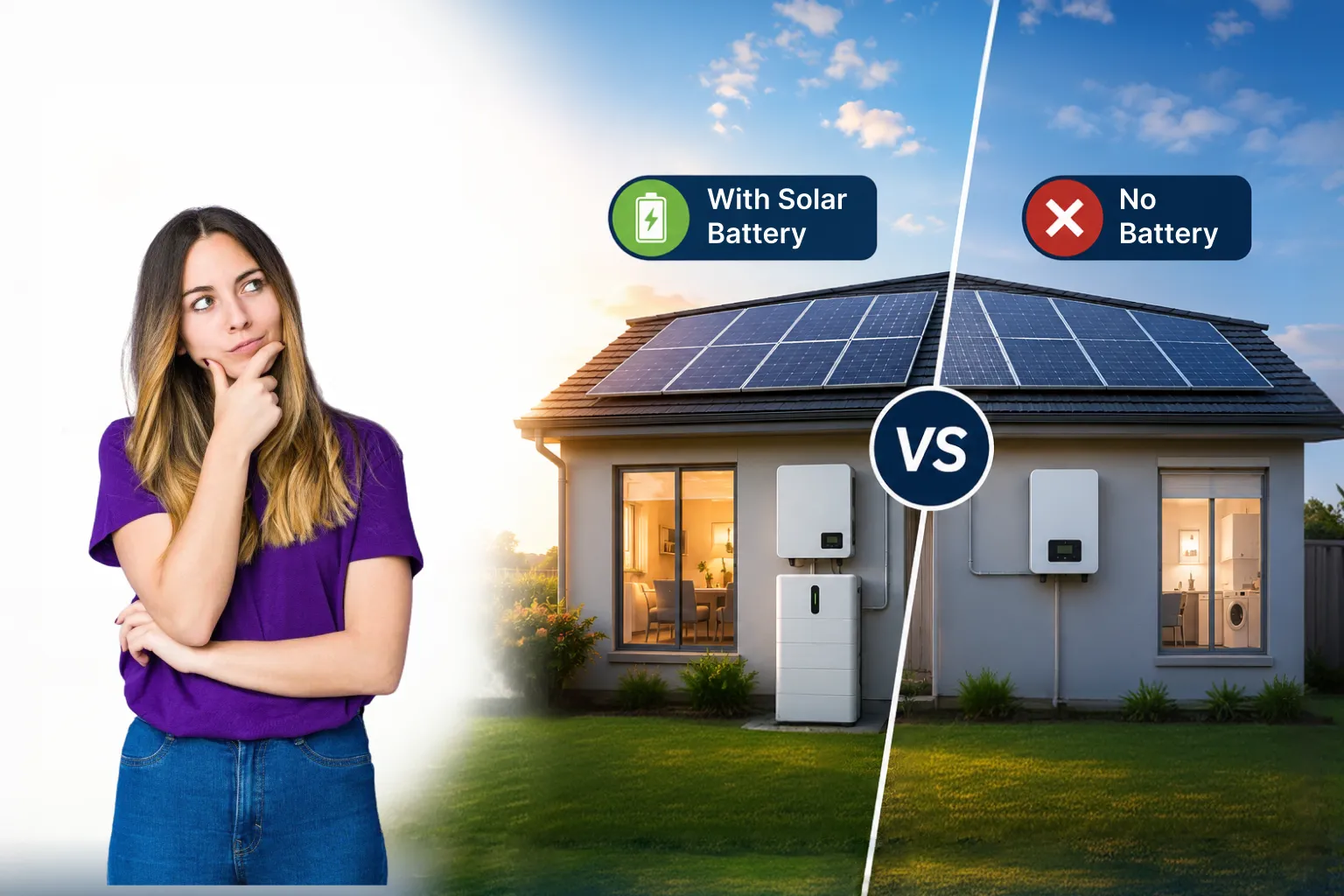
If you already have a 6.6kW or 10kW solar system, you’re likely exporting cheap power during the day… then buying it back at a higher rate after sunset.
That’s why battery enquiries have surged heading into 2026.
But the real question isn’t whether you should get one.
It’s this - What size solar battery do i need?
Let’s break it down properly.
Most Australian homes need a 10kWh to 15kWh solar battery.
The right solar battery size depends mainly on your evening usage, not your daytime solar production.
When people search for solar battery size for home or solar battery sizes Australia, they’re usually comparing these standard capacities:
|
Battery Capacity (kWh) |
Best For |
Typical Use Case |
|
5kWh |
Small homes |
Light evening usage |
|
10kWh |
Standard households |
Covers most peak rates usage |
|
13kWh |
Families |
Higher self-consumption |
|
15kWh |
Large homes |
Strong blackout backup |
|
20kWh+ |
EV owners / big loads |
Heavy night charging & full backup |
Battery capacity (kWh) = how much energy you can store.
If your home uses:
You’ll need around 15kWh battery capacity to cover most of that without using grid power.
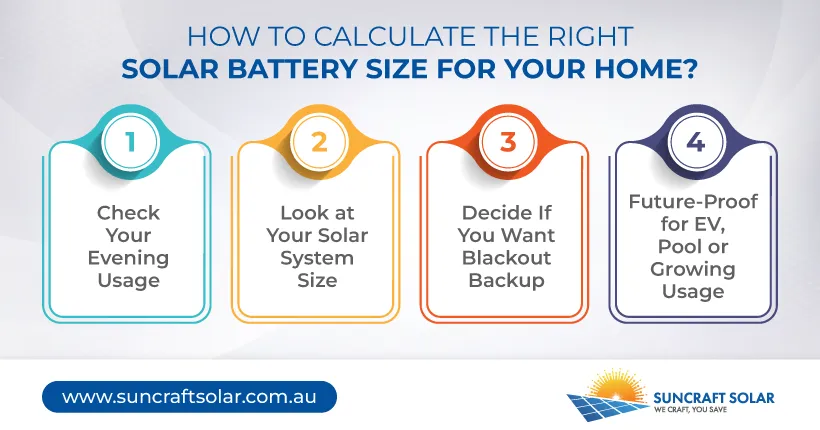
Here’s a simple step-by-step approach.
Look at your power bill or monitoring app.
Focus on:
Most Aussie homes use 8–15kWh during peak evening hours.
That number is your starting point.
If you already have:
The key question is not production but how much of that you’re exporting at a low feed-in tariff.
A properly sized battery increases self-consumption instead of selling cheap power back to the grid.
Some households just want to reduce peak rates.
Others want serious blackout backup.
If backup is important, you may want:
This increases required solar battery size.
Planning to buy an EV?
Even slow overnight charging can use:
That alone can justify moving from:
Future-proofing is smart in 2026.
This is where most existing solar owners sit.
If You Have a 6.6kW System
Recommended battery range:
Why?
If You Have a 10kW System
Recommended battery range:
Why?
Matching the battery to your solar system ensures you’re storing what you actually generate.
Let’s address the real question people ask besdies what size solar battery do i need?:
Is solar batteries worth it?
In 2026, the answer depends on three things:
Many states now offer:
But evening peak rates can be:
Storing power instead of exporting it makes financial sense.
If most of your usage is:
A battery significantly reduces peak power bills.
Some buyers care about:
Payback periods in 2026 typically range from:
Rebates available in 2026 in some states improve the numbers further.
For many higher-income households, the value isn’t just ROI.
It’s control.
Many Australian households are now on time-of-use tariffs. That means:
If your peak rate is 40+ cents per kWh, storing your own solar becomes far more valuable than exporting it at 5–8 cents per kWh.
But if you’re on a flat tariff with modest peak differences, the financial impact may be smaller.
The right battery decision isn’t just about battery capacity kWh. It’s about how your retailer charges you. A quick tariff review often changes the recommended solar battery size more than people expect.
If you already have solar, your inverter app holds the answers.
Instead of estimating, look at:
For example, if you regularly export 18kWh daily but import 12kWh at night, that’s a strong indicator a 13–15kWh battery could dramatically increase self-consumption.
This data-driven approach prevents oversizing and avoids paying for storage you won’t fully use.
This is one of the most common sizing debates.
Pros:
Cons:
Pros:
Cons:
For most homes with a 6.6kW or 10kW system, 13–15kWh is becoming the “sweet spot” solar battery size in 2026.
Most people don’t want a technical answer. They want to know what it means for their power bill and they often ask, what size solar battery do i need?
If your home uses around 10–15kWh between 4pm and midnight, a properly sized battery can cover most of that. That means instead of buying power at peak rates, you’re using your own stored solar energy.
For many homes in NSW, QLD, WA and SA, this shifts grid reliance from daily to occasional. You still pay your supply charge, and you may import some power during long cloudy stretches, but your exposure to high evening rates drops significantly.
This is where the right solar battery size makes the biggest difference. It’s not about eliminating your bill entirely. It’s about controlling the expensive part of it.
This is where many homeowners hesitate.
You might be thinking:
If that sounds familiar, your battery shouldn’t just match today’s usage. It should allow some breathing room.
Oversizing isn’t ideal, but undersizing can be frustrating. A 10kWh battery may suit you now, but if you plan to charge an EV overnight, a 13–15kWh system may be more appropriate.
When people ask, “What size solar battery do I need?” the honest answer is: the one that suits your future, not just your current bill.
Battery lifespan is another major consideration in 2026.
Most quality batteries come with:
Over time, battery capacity slowly reduces. That’s normal. A 13kWh battery might deliver slightly less usable storage after a decade, but it will still provide meaningful savings.
When evaluating solar panel battery sizes in Australia, it’s worth considering durability alongside capacity. A slightly larger battery today may still meet your needs comfortably years down the track as performance gradually declines.
This is why sizing isn’t just about today’s evening usage. It’s about long-term stability.
If you’re asking:
Here’s the practical answer:
Your ideal solar battery size depends on:
Batteries aren’t about maximum size.

If you already have solar and want to reduce evening peak rates, increase self-consumption, or improve blackout backup, the best next step is reviewing your actual usage data.
Our team can assess your power bill, look at your solar output, and recommend the right solution for your property.
Most Australian homes need a 10kWh to 15kWh battery. Smaller homes may suit 5–10kWh, while larger homes or EV owners may need 13–20kWh.
A 10kWh to 13kWh battery is usually ideal for a 6.6kW system, balancing cost and self-consumption.
Most 10kW systems pair best with a 13kWh to 20kWh battery, especially for higher evening usage.
Yes, for light to average evening usage (8–12kWh). It may not fully support EV charging or heavy air-conditioning.
A 15kWh battery stores more energy, covers more evening usage, and supports EV charging, but costs more upfront.
Check your evening usage (4pm–10pm). Your battery size should roughly match your typical evening and overnight consumption in kWh.
If you use 10–15kWh at night, a properly sized battery can cover most of that and reduce peak-rate grid usage
It can be worth it if you export electricity at 5–8c per kWh and buy power at 30–45c during peak hours. The actual savings depend on your household usage patterns and electricity tariff structure.
Yes. Electric vehicle charging can use 8–15kWh per night. Planning ahead may require upgrading from a 10kWh battery to 15kWh or more to handle both household and EV charging needs efficiently.
Not always. The best financial outcome comes from matching the battery size to your actual electricity usage and tariff structure. Oversizing a battery can increase upfront cost without delivering proportional savings.
Copyright © 2026 SUNCRAFT SOLAR | ABN : 38 689 488 266 | Licence Number : NSW : 486169C | SA: BLD 356274

